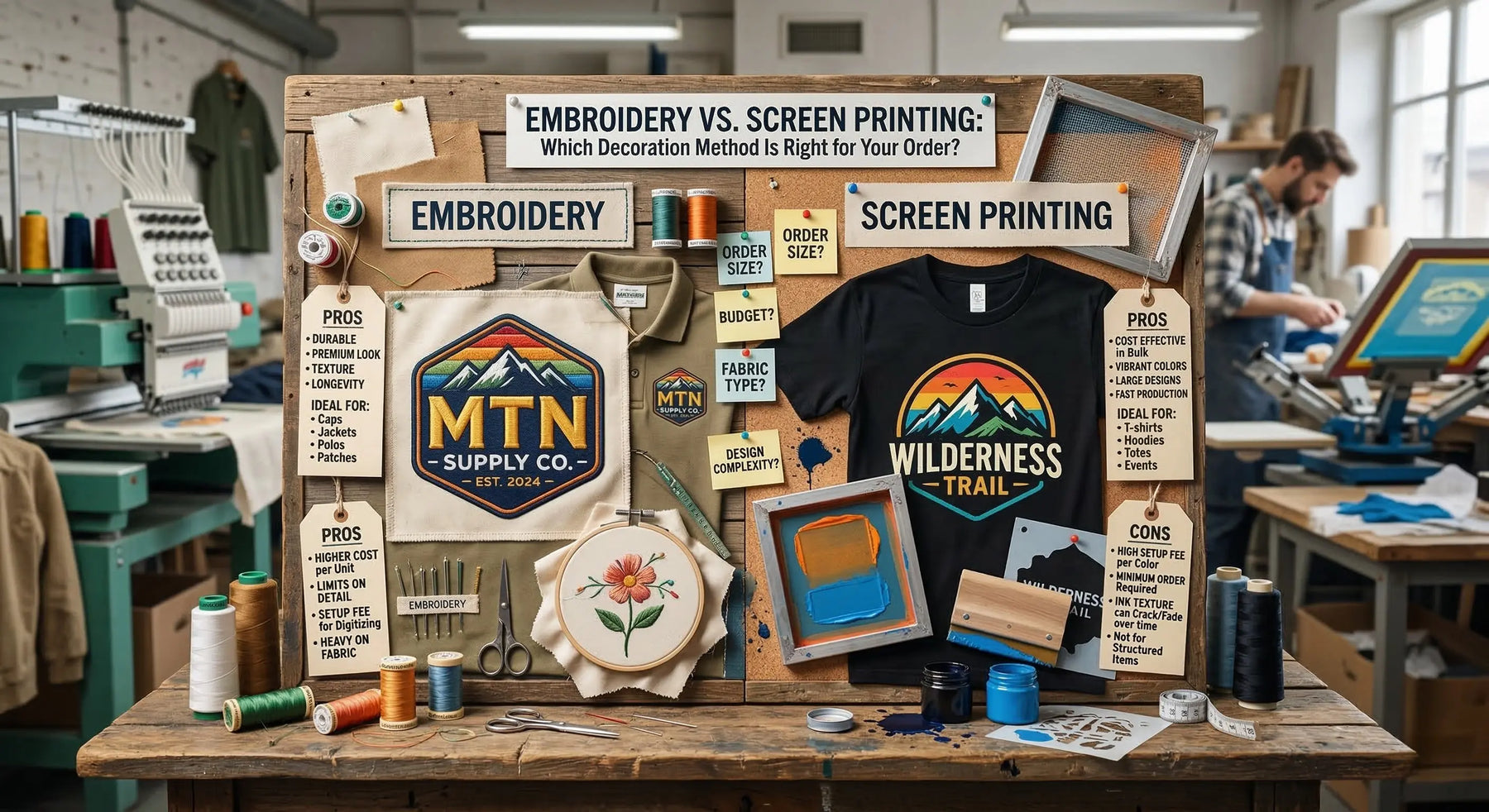
When you're ordering custom apparel for your business, team, or event, one of the first decisions you'll face is how your logo or design will be applied to the garment. Two methods dominate the custom apparel world: embroidery and screen printing. Both produce professional results — but they work best in different situations, and choosing the wrong one can affect how your finished product looks, feels, and lasts.
This guide breaks down the real differences clearly, without the jargon, so you can go into your order knowing exactly what you want.
|
The right decoration method depends on your garment, your design, your quantity, and the impression you want to make — not just price. |
What Is Embroidery?
Embroidery uses a computerized machine to stitch your design directly into the fabric using thread. The result is a raised, textured logo that feels premium to the touch and holds up exceptionally well through repeated washing. It's the decoration method you'll typically see on corporate polos, uniform hats, workwear jackets, and professional outerwear.
Because thread is the medium, embroidery works best with clean, bold designs — logos, wordmarks, and simple graphics. Fine detail and gradients are difficult to reproduce accurately with thread, but a well-prepared embroidery file on a clear logo looks sharp and durable for years.
|
BEST FOR EMBROIDERY Corporate uniforms · Polo shirts · Hats & toques · Outerwear & vests · Workwear & trade jackets · Dress shirts |
What Is Screen Printing?
Screen printing applies ink directly to the fabric surface using a stencil — or 'screen' — for each colour in your design. It produces bold, flat, vibrant graphics that are excellent for T-shirts, hoodies, and other casual apparel. Screen printing handles full-colour artwork well and becomes more cost-effective as order quantity increases.
It's the go-to method for event merchandise, team uniforms, camp gear, and any order where you need high-volume production with eye-catching visuals across the front or back of a garment.
|
BEST FOR SCREEN PRINTING Event T-shirts · Sports team uniforms · Camp & school gear · Hoodies & sweats · High-volume promotional runs · Tote bags & accessories |
Embroidery vs Screen Printing: At a Glance
|
FACTOR |
✦ EMBROIDERY |
✦ SCREEN PRINTING |
|
Best For |
Polos, hats, outerwear, workwear |
T-shirts, hoodies, event & team gear |
|
Look & Feel |
Raised, textured — premium appearance |
Flat, smooth — bold & vibrant |
|
Detail Level |
Best for clean logos & wordmarks |
Handles fine detail & gradients |
|
Durability |
Extremely durable, outlasts the garment |
Very durable with quality inks |
|
Colour Range |
Up to ~15 thread colours |
Full CMYK or spot colours |
|
Ideal Quantity |
Any — great even on small runs |
Best value increases with volume |
|
Cost Profile |
Higher per-piece, reflects quality |
Lower per-piece at high volume |
|
Common Uses |
Corporate wear, uniforms, workwear, hats |
Events, sports, camps, campaigns |
When to Choose Embroidery
Embroidery is the better choice when your priority is a professional, polished appearance that holds up in demanding environments. It's especially well-suited for:
– Corporate uniforms and polos:Embroidery on a polo or dress shirt communicates professionalism. It's standard for client-facing staff, restaurant front-of-house, and office wear.
– Outerwear and jackets:Heavier garments like softshell jackets, winter coats, and fleece vests benefit from embroidery — screen printing doesn't adhere as cleanly to thick structured fabrics.
– Hats and headwear:The curved, structured surface of caps and toques makes them ideal for embroidery. Screen printing doesn't work well on hat panels.
– Workwear for trades:Construction, electrical, and plumbing crews need durable branded gear. Embroidery on work shirts and jackets withstands heavy use, washing, and outdoor conditions better than most alternatives.
– Small, premium orders:If you're ordering 10 embroidered polos for a client presentation or 24 hats for a corporate retreat, embroidery delivers per-item quality that matches the occasion.
When to Choose Screen Printing
Screen printing is the stronger option when you're working with larger quantities, big graphic designs, or garments where a flat, bold print is the right aesthetic. It's ideal for:
– Event T-shirts and merchandise:Screen printing's colour vibrancy makes it perfect for concert tees, festival gear, charity walk shirts, and community event apparel.
– Team uniforms and spirit wear:Sports teams, school clubs, and recreational leagues typically order high volumes of T-shirts or jerseys that call for screen printing.
– Camp and youth programs:Screen-printed designs with bold graphics and full colours are the standard for summer camps, sports camps, and school programs.
– High-quantity promotional runs:If you're ordering 300 branded T-shirts for a tradeshow or product launch, screen printing delivers consistent results at a lower cost per unit.
– Large back prints and oversized chest graphics:Designs that span the full front or back of a garment are handled best through screen printing.
How Cost Compares
Neither method is universally cheaper — it depends on your order specifics. Here's how to think about it:
– Embroidery costs are primarily influenced by stitch count (design complexity) and garment type. A simple chest logo on a polo costs less than a highly detailed design. Cost per piece stays relatively stable across small and large quantities.
– Screen printing involves setup costs per colour (creating the screens) that are spread across the run. The more you order, the lower your cost per unit — it rewards volume.
– Ordering 12 branded polos for your management team? Embroidery likely offers better value and appearance. Ordering 250 T-shirts for a community event? Screen printing will typically be more cost-effective.
|
When you request a quote, Budget Promotion can walk you through pricing for both methods based on your design, garment, and quantity — so you're not guessing. |
A Note on Design Preparation
Whichever method you choose, your design file matters. A few things to keep in mind:
– For embroidery:Vector files (AI, EPS, PDF) or high-resolution PNGs work best. Clean, simple logos convert most effectively. Highly detailed artwork may need to be simplified for thread reproduction.
– For screen printing:Vector artwork is ideal. If you're using spot colours, knowing your colour count matters — each colour adds a layer. Full-colour CMYK printing is also available for complex artwork.
If you're unsure about your file, the team can review it when you submit your quote request.
Can You Mix Both Methods on One Order?
Yes — and many customers do. It's common to order embroidered staff polos alongside screen-printed T-shirts for an event: a polo for management, a casual tee for volunteers. When you request a quote, you can specify different decoration methods for different garment types within the same order.
Which Method for Which Garment?
|
✦ CHOOSE EMBROIDERY FOR |
✦ CHOOSE SCREEN PRINTING FOR |
|
• Polo shirts |
• T-shirts (all sleeve lengths) |
|
• Baseball caps & toques |
• Hoodies & crewneck sweatshirts |
|
• Softshell jackets & outerwear |
• Athletic jerseys |
|
• Fleece vests |
• Shorts & sweatpants |
|
• Dress shirts & woven shirts |
• Tote bags |
|
• Workwear & trade jackets |
• Aprons & accessories |


