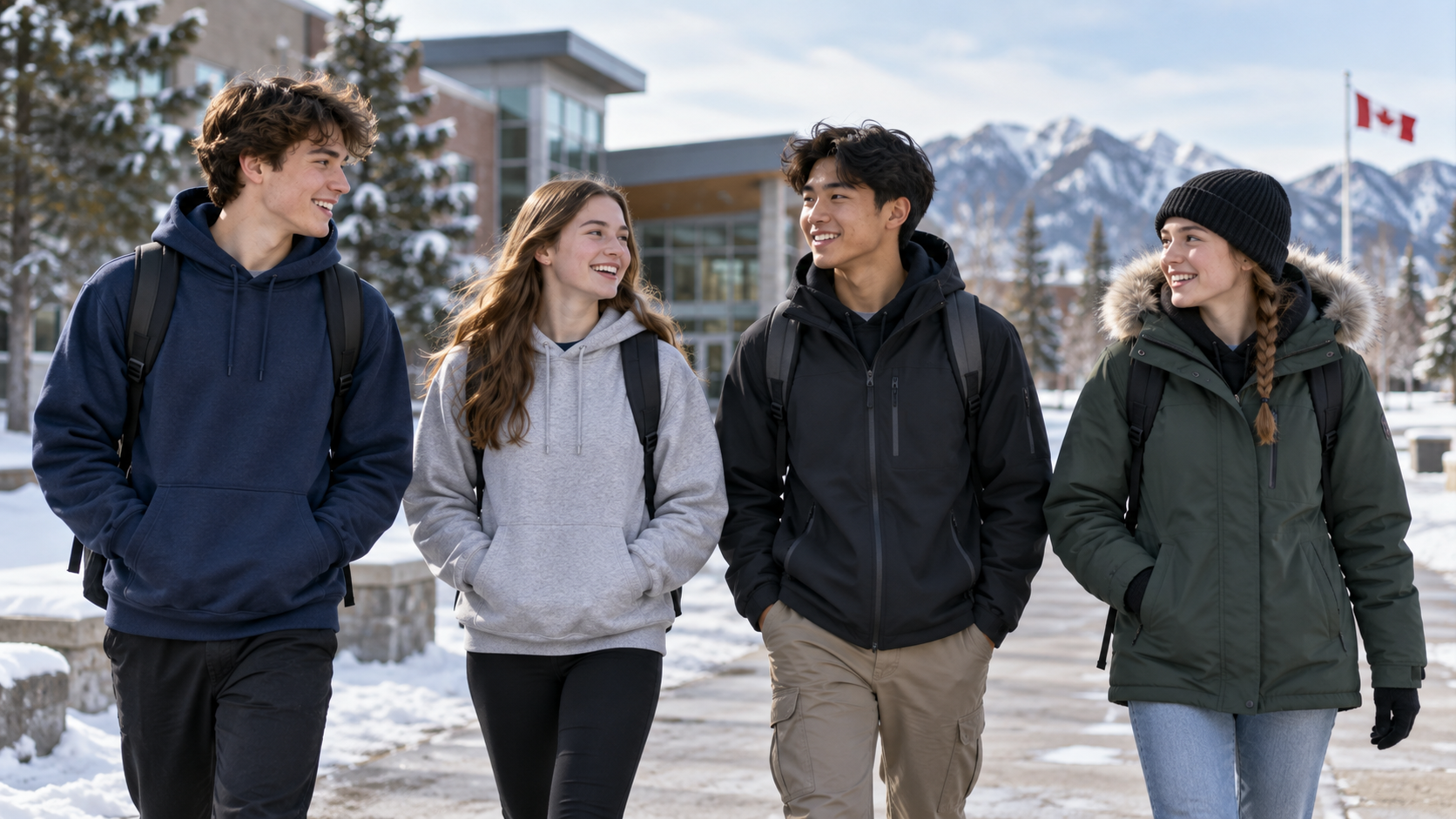
The best material for a durable school hoodie is3-end ring-spun cotton and polyester fleece between 260 and 340 GSM. Pick a 50/50 blend for shrink control, or an 80/20 ring-spun blend for softness and print quality. For school outerwear, the durable choice isa nylon or polyester shell over synthetic insulation with a PFAS-free water-repellent finish. Canadian schools push clothing harder than most fabric guides assume. The Calgary Board of Education recommends indoor recess only at -20°C including wind chill, so students play outside at -19°C.
Budget Promotion prints custom hoodies and embroiderscustom school apparel for schools, sports teams, and grad committees across Canada. This guide covers the specs that decide durability: blend, yarn, fleece construction, GSM, shell fabric, insulation, and decoration.
Why Do School Hoodies and Jackets Fail Before the Year Ends?
School apparel fails in four ways: pilling, shrinking, cracked prints, and lost warmth once the fabric gets wet.
A durable hoodie starts with the blank, not the print. One reviewer of a popular 8-ounce 50/50 hoodie wrote, "Very thin nothing heavy about these sweatshirts." A parent on the UK forum Mumsnet described a recycled polyester jumper as something she had to "de-bobble before every wear." Pilling starts where friction runs highest: backpack straps, desk edges, and locker doors.
Shrinkage numbers back this up. A Toronto print shop that decorates blank hoodies in volume measured 4.2 percent length shrinkage on a midweight 80/20 hoodie after a hot commercial wash. The same hoodie moved under 3 percent after a cold wash and a low-heat dry. That shop reports 3 to 5 percent shrinkage on a 50/50 budget hoodie dried hot.
Environment Canada rates wind chill between -28 and -39 as high risk. Exposed skin freezes in 10 to 30 minutes at that level.
Which Hoodie Fabric Blend Lasts Longest?
A 50/50 cotton and polyester fleece holds its size best, and an 80/20 ring-spun blend holds a print best. No single best hoodie material covers every school order.
Cotton and polyester each fail differently. Bella+Canvas states that in blends, "polyester may be more likely to pill and make the pills harder to remove." Cotton pills break away in the wash. Polyester pills stay anchored to the surface.
Four hoodie material options cover almost every school order:
-
50/50 cotton and polyester fleece. Lowest cost per unit, smallest shrinkage, widest colour range. The standard pick for bulk spirit wear.
-
70/30 or 80/20 ring-spun blends with a 100% cotton face. Softer hand, sharper prints, slightly more shrink risk at high dryer heat.
-
100% polyester performance fleece. Wicks sweat, keeps colour, dries fast. The right pick for sports teams and any polyester hoodie worn during training.
-
French terry. Looped inside instead of brushed, so it breathes better and adds less warmth. French terry versus fleece comes down to season. Terry suits September and May, and brushed fleece suits January.
Watch the colour you pick, because the same style often changes blend by colour. Gildan's Heavy Blend runs 50/50 in solids and 60/40 polyester in Heather Dark Maroon, Heather Dark Navy, and Heather Scarlet Red. Independent Trading's heavyweight runs 70/30 in solids and 52/48 in heathers. Bella+Canvas Heather Navy is 60/40, while its Athletic Heather is 90/10. School colours sit inside that heather range. Confirm the fibre content of your exact colour before approving the quote.
Do Yarn and Fleece Construction Matter More Than the Blend?
Yarn and fleece construction decide pilling and shape retention more than the blend ratio does.
Three construction details separate a four-year hoodie from one that looks worn by December:
-
Ring-spun or air-jet yarn. Ring-spun cotton gives a smoother face and resists pilling better than coarse open-end cotton. Gildan uses a finer air-jet face yarn on its Heavy Blend fleece to reduce pilling.
-
3-end fleece. A third yarn, called the tie yarn, locks the face and backing together. That yarn stops sagging and supports dense embroidery without puckering. ATC Everyday Fleece, Independent's 10-ounce heavyweight hoodie, and the KOI Element hoodie all use 3-end fleece.
-
Compacted yarn or cross-grain cutting. ATC compacts its yarns to reduce shrinkage. Champion solved the same problem in 1938 by cutting fleece on the cross grain, which resists vertical shrinkage.
Ask your supplier for a pilling grade. Random-tumble testing under ASTM D3512 grades fabric from 1 to 5, where 5 shows no pilling. A grade of 3.5 passes as commercially acceptable, and Canada runs its own random-tumble method through the Canadian General Standards Board. A blank marketed as pill resistant fleece without a grade behind it tells you nothing.
How Heavy Should a Custom School Hoodie Be?
Custom hooded sweatshirts worn under a winter jacket work best at 260 to 300 GSM. A hoodie worn as the outer layer works best at 330 GSM or heavier.
Canadian spec sheets measure weight differently than American ones. SanMar Canada lists the ATC Everyday Fleece hoodie at 13 ounces per linear yard, 7.8 ounces per square yard, and 264 GSM. All three numbers describe one fabric. A buyer comparing a Canadian "13-ounce" hoodie against an American "8-ounce" hoodie reads a difference that does not exist.
Three rules keep weight decisions simple:
-
Ask for GSM rather than ounces.
-
Match weight to the wear. A 264 GSM midweight fleece hoodie layers under a shell. A 330 to 434 GSM heavyweight hoodie carries a grad print and gets worn alone in fall.
-
Verify every high GSM hoodie claim. Independent's heavyweight lists 10 ounces per square yard, or 330 grams.
What Outerwear Materials Survive a Canadian School Winter?
A polyester or nylon shell over synthetic insulation survives a Canadian school winter, because synthetic fill keeps insulating after snow melts into it.
Shell fibre choice sets abrasion and weather behaviour. Nylon resists abrasion better, which matters for playground contact and backpack wear. Polyester resists UV damage better and absorbs almost no water, so it stays lighter once the water-repellent finish wears thin.
REI's gear guidance on insulation is direct. Down "loses insulating power when it gets wet and takes a long time to dry." Synthetic fill "continues to insulate even when wet." Slush, snowball fights, and wet benches make synthetic the practical fill for students. Down and down-hybrid jackets suit staff and grad gifts, where warmth per gram matters more.
Waterproof ratings translate like this:
|
Rating |
Real protection |
School use |
|
600 to 1,500 mm |
Light showers, brief exposure |
Wind layer, dry-day outerwear |
|
2,000 to 3,000 mm |
Moderate rain |
Spring and fall jackets |
|
5,000 mm and above |
Heavy rain, standing water |
Wet coastal winters, snow play |
Fabric ratings mean little without taped seams, since water enters through stitch holes. Parents who tested kids' winter coats across five children named sealed seams and reinforced wrist cuffs as the parts that kept working. One hardshell in that test was on its third child in five years.
Schools order custom jackets in four shapes. A softshell jacket bonded to brushed tricot blocks wind and light drizzle, and takes clean embroidery. A fleece jacket adds warmth as a mid-layer, absorbs moisture, and pills over time. A puffer jacket with polyester fill handles deep cold in youth sizes. Custom varsity jackets in melton wool with leather sleeves serve awards and grad programs. Comparecustom outerwear by season before choosing between them.
How Do Hoodies and Jackets Work Together for Students?
A hoodie works as the mid-layer and the jacket works as the windproof shell, so both garments get sized as one system.
Teen behaviour decides whether either garment gets worn. Kimberly Knull, a registered psychologist at Momentum Walk-In Counselling in Edmonton, explained to Global News that adolescents follow peer clothing choices even in extreme cold. A jacket left in a locker delivers zero warmth and zero brand visibility.
Custom Ink's 2026 Swag Trends Survey found 67 percent of organizers count a project successful only when people wear the gear voluntarily. That makes fit part of durability. A high school jacket gets worn for four years, so cut matters as much as shell fabric. Ordercustom winter jackets with room over a midweight hoodie, and students wear both.
Children aged 6 to 12 grow 6 to 7 centimetres per year, according to Nemours KidsHealth. Size youth outerwear one size up for multi-year use, and order keepsake hoodies true to size.
Which Materials Fit Each Type of School Order?
Material priorities change by group.
|
Order type |
Material to order |
Feature that matters most |
|
Elementary (K to 6) |
50/50 or cotton-face 3-end fleece, 264 GSM |
No hood or neck drawstrings in sizes 2T to 12 |
|
High school spirit wear |
Ring-spun 80/20 fleece, retail fit |
A cut students wear off campus |
|
Grad hoodies |
330 GSM and heavier 3-end fleece |
Keepsake quality and embroidery support |
|
Sports teams |
100% performance polyester fleece, custom zip up hoodies |
Wicking, colourfastness, low-bleed ink |
|
Staff and teachers |
Softshell or down hybrid |
Professional finish, sealed embroidery |
A Grade 3 hoodie needs safety and growth room. A grad hoodie needs weight and a print that survives a decade in a closet. Run both through oneschool spirit wear program to keep artwork consistent across grades.
Are Drawstrings Safe on Youth School Hoodies?
No drawstring belongs in the hood or neck of children's upper outerwear in sizes 2T to 12, under ASTM F1816-18.
Health Canada assesses children's jackets and hoodies against that standard. In its 2021 to 2022 compliance project, Health Canada sampled 46 children's upper outerwear products in sizes 0 through 16. It found 36 non-compliant, which produced 23 voluntary recalls and 4 stop-sale orders. A 2019 Canadian recall covered more than 2,000 children's hoodies and sweatshirts over drawstrings alone.
The US Consumer Product Safety Commission counts 26 deaths and 73 non-fatal incidents tied to neck and hood drawstrings between 1985 and 2019. Playground slides and school bus doors caused most of them. The Canadian Paediatric Society tells parents to remove drawstrings from clothing that can catch on play equipment.
Order cord-free youth hoodies instead of cutting cords out later. The KOI Element hoodie ships with a double-lined hood and no drawstrings, which keeps elementary orders compliant.
Which Decoration Method Lasts Longer on Fleece, Screen Printing or Embroidery?
Embroidery outlasts screen printing on fleece because thread cannot crack. Embroidered hoodies survive more wash cycles, and screen printing costs less per unit at volume.
Each method has a fabric requirement. Embroidery needs 8 ounces or heavier fleece for stability, and text under half an inch loses definition in dense thread. Screen printing needs a smooth, stable face, which is why cotton-face fleece prints sharper than brushed polyester. DTF transfers hold colour on dark fleece where screen ink needs a white underbase.
Polyester school colours carry one specific risk. Red polyester causes dye migration, where fabric dye reactivates around 130°C and bleeds into a light print. Standard plastisol cures at 160°C or higher, and low-cure inks cure at 132°C to 149°C. Dye migration takes days or weeks to appear. Maroon and red team hoodies need low-bleed ink and a test print before the full run.
Technical outerwear needs different handling. Embroidery punches thousands of needle holes through a waterproof layer, so decorators seal the back of the design with laminate film. Heat transfers on nylon need an aggressive adhesive, or they peel after a few washes. Nylon shells need catalyzed ink rather than standard plastisol.
Are Durable Fabrics Also the Better Environmental Choice?
Durable fabric is the lower-impact choice, because replacement orders carry the largest footprint in school apparel.
Ocean Wise, a Vancouver research group, found an average household in Canada and the US releases 533 million microfibres into wastewater each year, or 135 grams. Their testing showed mechanically treated polyester fleece sheds the most, and durable nylon sheds the least. Cold washes and fuller loads cut that number.
Water-repellent finishes are changing too. Canada concluded in March 2025 that PFAS, excluding fluoropolymers, harm human health and the environment. The plan names textiles in Phase 2 of the phase-out. Several jackets stocked in Canada already carry PFAS-free repellent finishes, including Coal Harbour softshells, youth puffy jackets, and Stormtech PFC-free shells.
How Do You Check Quality Before Placing a Bulk Order?
Check eight specs before approving a quote, then wash-test one sample.
-
Fibre content for your exact colour, not the style average.
-
Yarn type: ring-spun, combed, or air-jet.
-
Fleece construction: 2-end or 3-end.
-
Weight in GSM.
-
Pilling grade against ASTM D3512, at 3.5 or better.
-
Shrinkage percentage after a home wash.
-
Drawstring status for every youth size.
-
Taped seams and a waterproof rating for outerwear.
Wash the sample five times in cold water with a low-heat dry. Check the print edges and cuff recovery afterward. ASI's 2026 study of Canadian consumers found 73 percent say quality influences whether they buy or keep a branded item. A wash test costs one garment and protects a 300-piece order.
Check the label rules too. A school store that removes tear-away labels and relabels garments still needs fibre content in English and French, plus a dealer name or CA identification number, under Canada's Textile Labelling Act. Comparecustom merchandise at that spec level rather than on price alone.
What Does a Durable School Hoodie Cost per Wear?
A $19.99 hoodie worn twice a week across one 38-week school year costs 26 cents per wear.
Run the same hoodie through a second year and the cost drops to 13 cents per wear. A cheaper hoodie that pills by February and gets abandoned costs more per wear than the better blank. ASI's 2026 impressions research puts fleece, jackets, and sweatshirts at roughly 9,000 brand impressions over their lifetime. That works out to under half a cent per impression.
Frequently Asked Questions
Where Should I Order Custom Spirit Wear for My School? Order from a supplier that prints in-house and publishes fibre content and GSM per style.Budget Promotion produces school spirit wear across Canada with no minimum order requirement, so a 20-piece club order and a 400-piece school run both work.
What's the Difference Between Custom Apparel and Regular Clothing? Custom apparel starts as a blank garment chosen by spec, then carries your artwork.Blanks publish blend, weight, yarn, and shrinkage data that retail labels leave out. That data lets you compare durability before buying 300 pieces.
How Long Does It Take to Receive Custom School Apparel? Most apparel orders finish in 5 to 10 business days after mockup approval.Rush production runs faster for grad dates and season openers, with fees applied per order. Place grad hoodie orders 8 to 10 weeks before the ceremony to allow for artwork revisions and name lists.
What Are the Minimum Order Quantities for Custom School Clothing? Budget Promotion carries no minimum order requirement, so quantities match the group.Price breaks start at 25 pieces, then grow at 100 and 500 pieces. Parent councils often combine grade orders into one run to reach the next break.
How Do I Measure Correctly When Ordering Custom Apparel? Measure a hoodie the student already wears, laid flat. Record chest width armpit to armpit, body length from the highest shoulder point, and sleeve length.Compare those three numbers to the size chart rather than guessing by age, then add growth room for youth outerwear.
What Questions Should I Ask Before Ordering Custom Apparel? Ask for fibre content by colour, GSM, pilling grade, shrinkage percentage, drawstring status in youth sizes, and ink type for red or maroon polyester.Ask for a physical sample of the exact blank, then wash it before approving the full order.
Why Choose Budget Promotion for Custom School Hoodies and Outerwear?
Budget Promotion is a Canadian custom merchandise team that supplies schools, sports teams, camps, and workplaces with apparel built for how students actually wear it.
Most orders finish in 5 to 10 business days after mockup approval, with rush options for grad and season deadlines. There is no minimum order requirement, so a small club order and a full school run get the same handling. Every design goes through unlimited mockup revisions before production. Production happens in-house, and we price match competitor quotes on comparable quality. More than 20,000 companies and organizations across Canada have ordered custom merch through Budget Promotion, including school hoodies, grad hoodies, team jackets, and staff outerwear.
Start with thecustom promotional products and branded apparel lineup. Then request a quote with the eight specs above, plus a sample of the blank you plan to order.


