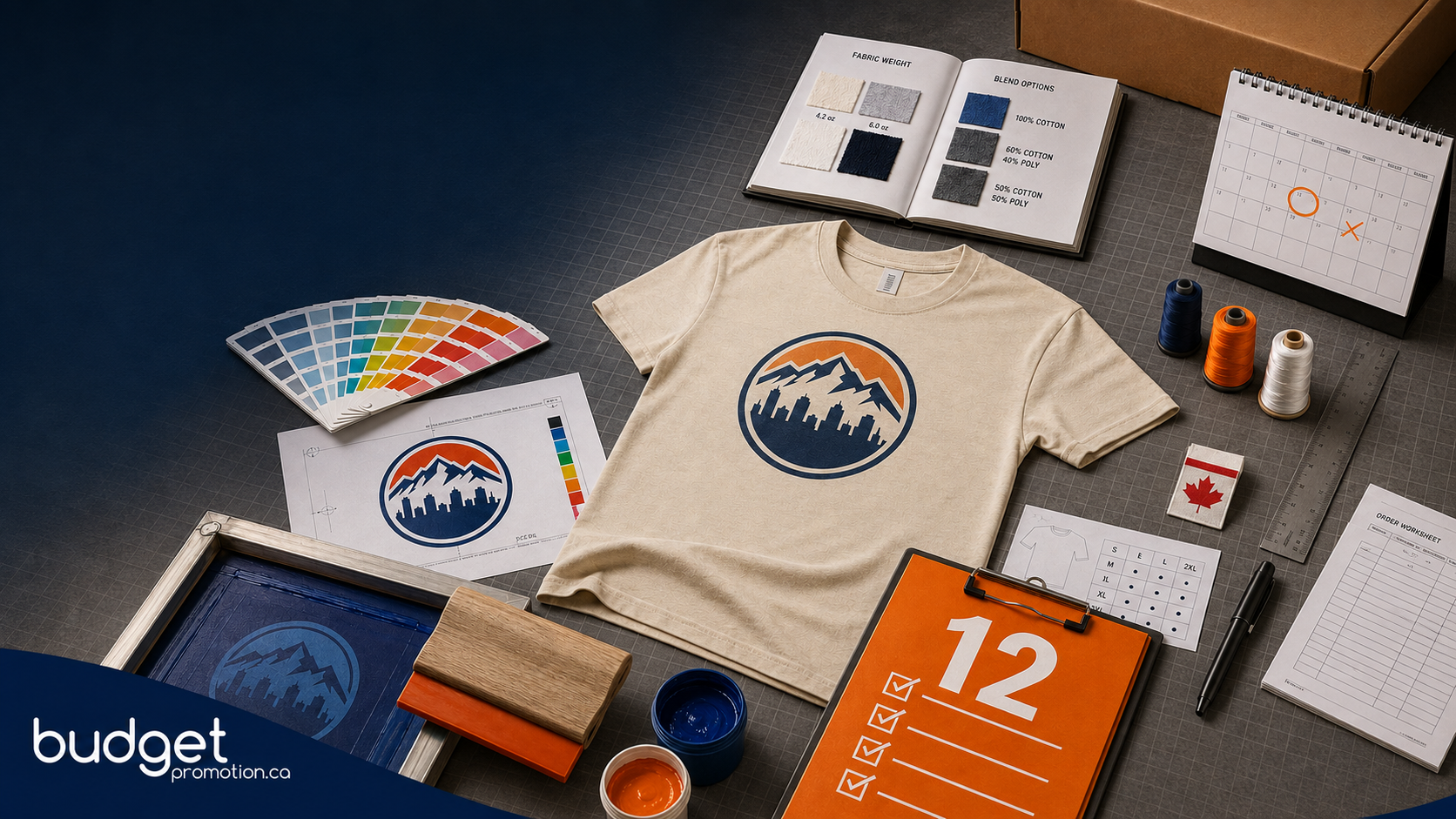
Twelve questions separate a custom t-shirt order that works from one that wastes money. Ask aboutfabric weight, shrinkage tolerance, print method, artwork format, and colour matching. Ask what the quote includes, what the minimum is, and how long production runs. Ask where the blanks are made, whose name appears on the label, and whether youth sizes carry test certificates. Ask whether you can reorder the same shirt in six months. A good supplier answers all twelve in one conversation. Buyers who skip them find out after the box arrives.
Which Questions Cover the T-Shirt Itself?
Four questions cover the garment: fabric composition, fabric weight, shrinkage tolerance, and country of manufacture. The blank decides how the shirt feels on day one and whether anyone wears it on day ninety. Print quality sits on top of that decision.
Which Fabric and Weight Fit Your Purpose?
Fabric weight and fibre content decide comfort, durability, and price. Cotton jersey runs from roughly 4.2 oz for lightweight fashion tees up to 6.1 oz for heavyweight styles. Ring-spun and combed cotton feel softer than open-end cotton. The fibres get twisted and cleaned more thoroughly before knitting.
Tri-blends mix cotton, polyester, and rayon for drape and stretch. Polyester blends dry faster and hold their shape through repeated washing. That suits kitchen crews and athletic teams. Heavier fabric costs more per unit and lasts longer. Compare weights across thecustom t-shirts Calgary range before picking a style.
Corporate buyers have started paying for the heavier option. The Custom Ink 2026 Swag Trends Survey polled more than 1,000 corporate buyers.45% ranked durability as the most important feature, and 62% planned to try heavyweight fabrics.
How Much Does a Pre-Shrunk T-Shirt Shrink?
Pre-shrunk describes a tolerance, not zero movement. The Sanforized specification permits knitted fabric to move up to5% in either direction. Untreated ring-spun cotton jersey loses 5% to 10% of its length in a hot wash and tumble dry. A cold wash with air drying costs 1% to 3%.
Measured results vary between blanks. One comparative test washed three pre-shrunk 100% ring-spun styles under identical conditions. Results came back at 0% on the Anvil 780, 3.5% on the Next Level 3600, and 5.33% on the Gildan 64000. Cotton Incorporated documents in its ISP 1009 guidance that70% to 90% of a garment's lifetime shrinkage happens during the first three wash cycles.
Ask your supplier for the published tolerance on the exact blank in your quote. For shirts staff wash weekly, size up one step or pick a style with a lower measured figure.
Where Are These Blank T-Shirts Made?
Country of manufacture sets your duty exposure, and the brand name does not answer the question. Gildan spins its cotton in North Carolina and Georgia. The company knits and dyes that fabric in Honduras and the Dominican Republic. Sewing happens in Honduras, Nicaragua, the Dominican Republic, or Haiti. American cotton produces a Honduran-origin shirt.
Origin for customs purposes follows where the garment was made, not where the fibre grew. That distinction decides which tariff line applies to your order in 2026. Ask for country of origin on the quote before approving it.
What Do You Ask About Printing?
Three questions cover decoration: which method suits the design, how close the colour match gets, and whether the artwork file works at production size. Print method drives both the unit price and how the shirt looks after fifty washes.
Which Print Method Fits Your Design?
Print method depends on quantity, colour count, and design detail.Screen printing costs least per shirt on large runs. The ink lays down thick and the press runs fast, though each colour needs its own screen.Direct-to-garment (DTG) prints photographic detail with no setup, which suits short runs and complex artwork.DTF transfers print on cotton, polyester, and blends without a separate white underbase step.Embroidery stitches the logo into the fabric and reads as more formal, which suits polos and outerwear more than tees.
Simple two-colour logos on 100 shirts favour screen printing. Full-colour photographs on 15 shirts favour DTG. Mixed fabrics across one order favour DTF.
How Close Does a Pantone Match Get on Fabric?
No industry standard governs colour matching on garments. Rick Roth of The Ink Kitchen states the position directly: most inks are translucent, so ink film thickness changes the printed colour. A white underbase on a dark shirt shifts it again. Discharge results differ depending on which mill dyed the blank, because shirts in one order can come from different plants in different countries.
Humidity, squeegee pressure, mesh count, and platen temperature all move the result.Request a strike-off printed on the exact garment and colour you ordered for any brand-sensitive job. Ask what variance between shirts the shop treats as acceptable before production starts.
Is Your Artwork Print-Ready?
Vector files produce the cleanest print. AI, EPS, and SVG formats scale to any size without losing edge quality. A logo drawn as vector art prints the same at 3 inches or 12 inches. Raster files need300 DPI at full print size. A 72 DPI web graphic pulled from a website loses detail on fabric.
Count the colours in your design before requesting a quote, because screen printing charges by colour. Confirm the print locations too. A front chest print plus a back print doubles the setup on a screen-printed job.
Which Questions Protect Your Budget and Deadline?
Four questions cover commercial terms: what the quote includes, why the minimum exists, how long production takes, and whether the count matches. These questions cost nothing to ask and protect the budget line.
What Does the Quote Include?
A complete quote lists the garment, decoration, setup, artwork, shipping, and taxes as separate lines. Screen setup fees apply per colour per location. Art preparation fees apply when a logo arrives as a photograph or a low-resolution file. Rush fees apply when production compresses.
Two more questions apply to any order crossing a border. Does the quote include duty and brokerage? Who acts as the importer of record? Canada applies a most-favoured-nation duty of18% on apparel classified in HS chapters 61 and 62. That drops to 0% under CUSMA, CETA, and CPTPP. GST of 5% applies at the border on value plus duty.
Budget Promotion produces in-house in Calgary, which keeps decorations on domestic soil for Canadian orders. See the fullbranded apparel Calgary range for what that covers. Ask any supplier where decoration happens and where the blanks ship from.
Why Do Screen Printers Set Minimum Orders?
Minimums exist because setup costs stay fixed regardless of run length. Art preparation, film output, screen burning, press setup, and takedown consume the same labour on 12 shirts as on 500. Standard screen printing minimums start at12 pieces, rising to 50 or 72 at shops running larger automatic presses. Printers target 20% to 45% margin per job.
Digital methods change the arithmetic. DTG runs as low as a single shirt because setup amounts to loading a file. DTF transfers sit between the two. Ask for the minimum on the specific method and garment you want, since one shop can quote three different figures.
How Long Does Production Take?
Production time and transit time are two separate numbers, and suppliers quote them separately. Ask for the production window in business days after artwork approval, then add shipping days on top. Approval delays extend both. A proof sitting unapproved for four days pushes the whole schedule to four days.
Orderthree to four weeks ahead of a fixed event date to avoid rush charges. Large orders, multi-location prints, and specialty decoration all extend the window. Confirm the drop-dead approval date in writing at the time you place the order.
Does the Box Contain the Quantity You Ordered?
Under-runs happen in decorated apparel, and most quotes stay silent on the policy. A shirt can misfeed, an ink pull can smear, or a garment can arrive from the mill with a flaw. Order 100 shirts for 100 named staff, and 97 wearable shirts creates a problem no discount fixes.
Ask two questions before approving the quote.Do you charge for quantity ordered or quantity delivered? What happens if the run comes up short? Ask for the spoilage allowance in writing on orders where every recipient is named.
Which Compliance Questions Apply in Canada?
Three compliance questions apply to Canadian custom apparel buyers. Who appears as the dealer on the label? Do youth sizes carry test documentation? How do 2026 tariffs affect the landed cost? No supplier volunteers these. Ask them.
Whose Name Goes on the Label?
Canada's Textile Labelling Act defines a dealer as any manufacturer, processor, finisher, retailer, importer, or seller of a consumer textile product in Canada. Replace the manufacturer's neck tag with your own branded label and you take on that role.
A compliant label carries the generic name and percentage of every fibre making up5% or more of the total mass. It also carries either your name and business address or aCA identification number, in English and French. Penalties under the Act reach $5,000 on summary conviction and $10,000 on indictment. Competition Act penalties for corporations reach $10 million, or $15 million for a subsequent violation.
Ask your supplier whose CA number goes on a relabelled garment and who takes responsibility for the fibre content declaration.
Are the Youth Sizes Tested and Tracked?
Children's apparel carries obligations that adult apparel does not. Under the US Consumer Product Safety Improvement Act, children's products require testing at aCPSC-accepted accredited laboratory. They also require permanent tracking information on the product and its packaging. That tracking information names the manufacturer or private labeller, the production location and date, and a batch or run number. Printers usually place it on a printed neck label.
Ink chemistry matters on youth garments too. Ask for phthalate-free plastisol or water-based ink. Schools, minor sports clubs, and family events order youth sizes constantly, so raise the question at quote stage rather than after delivery.
Do Tariffs Change Your Cost in 2026?
Two tariff measures affect Canadian apparel buyers right now. The United States applied an additional50% duty on Canadian-origin goods under Section 338 of the Tariff Act of 1930. Apparel in HS chapters 61 and 62 falls inside it. The duty took effect at 12:01 a.m. Eastern on 22 August 2026. The measure carries no CUSMA exemption and no in-transit relief, so the entry date governs rather than the ship date.
Canada applies a50% counter-tariff on a list of US-origin products from 8 September 2026. The Department of Finance list names tariff item 6109.10.00, covering cotton t-shirts, singlets, and other vests, knitted or crocheted.
Both measures follow country of origin, which returns you to the question about where the blanks were made. Most blanks sold in Canada come from Central America or Asia rather than the United States. The counter-tariff hits a narrower set of styles than the headlines suggest. Ask your supplier to confirm origin per style, per shipment.
Raw material costs have stayed calmer than trade policy. ICE December 2026 cotton futures closed at91.38 cents per pound on 28 August 2026. Statistics Canada recorded the clothing and footwear index up 1.91% year over year in July 2026, against overall CPI growth of 3.0%.
What Do You Ask Before a Reorder?
Four questions decide whether you can repeat an order: dye lot policy, style availability, file retention, and artwork ownership. A uniform programme that cannot be repeated is not a uniform programme.
Dye lots vary between production runs. A colour difference of2% to 3% between lots counts as normal in the trade. It stays invisible unless garments sit side by side. Blank styles get discontinued on a two to five year cycle as manufacturers update their lines.
File retention varies more than buyers expect. Some vendors keep artwork and ink formulas indefinitely, and some purge digital files after 90 days. Ask how long your supplier holds separated production files, mixed ink formulas, and approved proofs. Ask whether they flag you before a style you depend on leaves the catalogue.
Settle ownership on the first order. Moving suppliers means paying setup twice and accepting a colour shift, if the shop treats separated films, screens, and ink formulas as its own property. Ask who indemnifies whom if a design turns out to infringe a trademark.
Which Questions Change by Industry?
Six buyer types ask different follow-up questions: events, schools, camps, sports teams, skilled trades, and restaurants. The twelve core questions apply to everyone. The priorities underneath them shift with how the shirt gets used.
What Do Event Organizers Ask?
Event buyers work backward from one fixed date, so the approval deadline matters more than the unit price. Ask for the last date artwork changes remain possible without a rush fee. Ask for the size curve you can still adjust after ordering.
Order 5% to 10% above your headcount for walk-ups and replacements. Single-colour screen prints on light garments cut both cost and production time. Budget Promotion carriesCustom Event Apparel & Merch for festivals, corporate events, and community celebrations.
What Do Schools Ask?
Schools order youth sizes, so testing and tracking documentation moves to the top of the list. Ask for the CPSIA test certificate and the tracking label on any youth garment. Ask for phthalate-free ink by name.
Spirit wear repeats year after year, which makes dye lot and file retention questions practical rather than theoretical. Confirm the supplier holds your school crest artwork on file and flags style discontinuations. Education accounted for10.5% of Canadian promotional product sales in the PPAI and PPPC Canadian Sales Volume Study. Budget Promotion suppliescustom school spirit wear and uniforms for Calgary students and faculty.
What Do Summer Camps Ask?
Camp shirts get worn hard, washed hot, and worn again the next day. Shrinkage tolerance matters more here than in any other category, so ask for the published figure and size up accordingly. Cotton and polyester blends hold shape better than 100% cotton through daily laundering.
Ask about colour visibility too, since staff use shirt colour to identify groups at distance. Order counsellor and camper colours in the same production run to keep the dye lots matched. Budget Promotion stocksCustom Camp Apparel & Merch for summer camps and outdoor programmes.
What Do Sports Teams Ask?
Teams need names, numbers, and roster changes, which turns a simple print into a variable-data job. Ask how the shop handles individual names, what it charges per name, and how late a roster change can arrive. Ask whether replacement singles are possible mid-season and what the reorder minimum is.
Moisture-managing polyester suits practice and game wear better than cotton. Confirm the decoration method survives repeated washing at the temperatures athletes actually use. Budget Promotion producescustom sports jerseys and team apparel for hockey, soccer, volleyball, and basketball programmes.
What Do Skilled Trades Ask?
Trade crews wear branded shirts as workwear, so fabric durability and colour retention outrank fashion fit. Ask about heavyweight cotton or poly-cotton blends rated for daily wear. Ask whether the print survives industrial laundering and how the colour holds under sun exposure.
Hi-vis requirements sit outside standard t-shirt decoration, so confirm what your site rules demand before choosing a garment. Construction accounted for11.5% of Canadian promotional product sales. Only business services bought more. Budget Promotion offersCustom Trade Merchandise & Apparel built for construction, plumbing, and electrical crews.
What Do Restaurants Ask?
Restaurant shirts face grease, heat, and daily washing, and front-of-house and back-of-house need different garments. Ask about stain behaviour on light colours and whether darker options exist in the same style. Ask about fabric weight for kitchen heat, since heavyweight cotton traps warmth.
Staff turnover makes reordering constant, so file retention and style availability questions carry real weight. Ask whether the supplier holds a standing order file with your sizes and artwork. Budget Promotion suppliesCustom Restaurant Apparel & Merch for front-of-house and food service teams.
How Do You Measure the Return?
A branded t-shirt generates roughly3,500 impressions over its lifetime at a cost per impression of about one third of a cent. That figure comes from the 2026 ASI Ad Impressions Study, which surveyed close to 5,000 consumers across the United States, Canada, Mexico, and Europe. Four in five consumers keep a promotional t-shirt for at least a year, and nine in ten wear it at least once a month.
Those numbers depend entirely on whether people choose to wear the shirt. The Custom Ink survey found67% of corporate buyers count a swag investment successful only when recipients voluntarily wear the item. Another 24.6% now describe the standard unisex cotton tee as overdone. Cheap shirts produce no impressions from a drawer.
Environmental performance holds up under measurement. A joint PPAI and ASI study published in February 2026 measured the footprint. Promotional products generate 0.7 grams of CO2 equivalent per memorised impression against 5.6 grams for digital advertising. 51toCarbonZero ran the research, certified to ISO 14067 by Bureau Veritas.
The twelve questions in this article point at one outcome: a shirt people put on again. Budget Promotion has producedCustom Merchandise & Branded Apparel businesses reorder for three decades, with in-house production and same-day service on urgent jobs. Browse theCustom T-Shirts collection for ATC, Bella + Canvas, Gildan, Next Level, and Nike blanks. Send your artwork and quantity for a quote that answers all twelve questions in writing.
Frequently Asked Questions
How far in advance should you order custom t-shirts?
Order three to four weeks before a fixed event date. That window covers artwork approval, production, and shipping without rush charges. Large quantities, multi-location prints, and embroidery extend it further. Approval delays push the whole schedule, so confirm your drop-dead approval date when placing the order.
How much do custom t-shirts shrink after washing?
Untreated ring-spun cotton jersey shrinks 5% to 10% in a hot wash and tumble dry, and 1% to 3% washed cold and air dried. The Sanforized specification permits knits up to 5%. Cotton Incorporated documents that 70% to 90% of lifetime shrinkage occurs within the first three washes.
What is the minimum order for screen printed t-shirts?
Screen printing minimums start at 12 pieces at most shops, rising to 50 or 72 where larger automatic presses run. Fixed setup costs drive the figure: art preparation, film, screen burning, and press setup cost the same on 12 shirts as on 500. DTG prints as few as one.
Can you mix sizes and colours in the same order?
Most shops allow mixed sizes freely within one style, since the print setup stays identical. Mixing garment colours can change the ink formula, because a design printed on white differs from the same design on navy. Ask whether mixed colours count toward one minimum or several.
What artwork file format do t-shirt printers need?
Vector files work best: AI, EPS, and SVG scale to any print size without losing edge quality. Raster files need 300 DPI at full print size. A 72 DPI logo pulled from a website will not hold detail on fabric. Count your design colours before requesting a screen printing quote.
Do 2026 tariffs affect custom t-shirt prices in Canada?
The United States applied a 50% additional duty on Canadian-origin apparel effective 22 August 2026, with no CUSMA exemption. Canada applies a 50% counter-tariff on listed US-origin products from 8 September 2026, including tariff item 6109.10.00 for cotton knit t-shirts. Both follow country of origin.
Does a custom t-shirt need a Canadian label?
Yes, when sold or supplied as a consumer textile product in Canada. The label carries the generic name and percentage of every fibre at 5% or more of total mass, plus a name and address or a CA identification number, in English and French. Relabelling a garment makes you the dealer.
Which printing method lasts longest on a t-shirt?
Screen printing with properly cured plastisol produces the most durable result on cotton, because the ink film sits thick and bonds under heat. DTF transfers hold well across cotton, polyester, and blends. DTG prints softest but shows wear soonest on dark garments requiring a white underbase.
Can you reorder the exact same custom t-shirt later?
Not guaranteed. Dye lots vary between production runs, and a 2% to 3% colour difference counts as normal. Blank styles get discontinued on a two to five year cycle. Some suppliers purge digital artwork files after 90 days. Ask about file retention and style availability before your first order.
How many impressions does a branded t-shirt generate?
A branded t-shirt produces roughly 3,500 impressions over its lifetime at about one third of a cent per impression, according to the 2026 ASI Ad Impressions Study of nearly 5,000 consumers. Four in five keep the shirt at least a year, and nine in ten wear it monthly.


