A polyester-blend polo wicks sweat better than a cotton one. That fact alone doesn't tell a camp director which shirt survives a full day of sunscreen and pool water, tell a school athletics coordinator which spirit wear holds its print through August practices, or tell a construction foreman which vest keeps a crew visible without adding to heat stress on site.
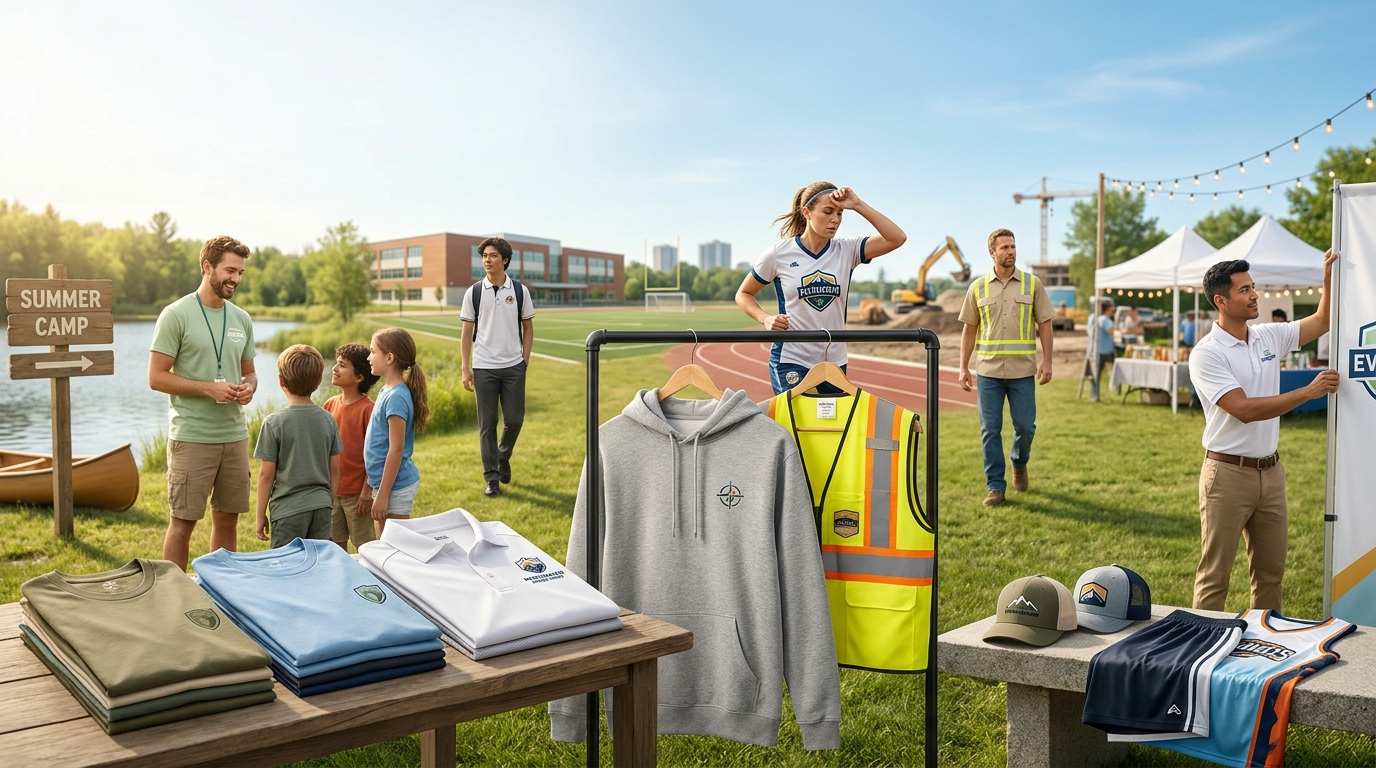
Summer apparel decisions change based on who wears the gear and where they wear it. The fabric, the decoration method, the sizing range, and the order timeline all shift depending on the type of organization behind the order, even when the supplier stays the same. This guide covers five program types that order Canadian custom apparel every summer: camps, schools, sports teams, skilled trades, and events. Each section below covers what actually changes for that group, and two comparison tables near the end cover ordering lead times and decoration durability across all five.
Cotton vs. Polyester: The Short Answer
Cotton breathes well in dry heat and feels soft against the skin, but it holds onto sweat and gets heavier as the day goes on. Polyester and poly-blends move moisture away from the body instead of absorbing it, which keeps the fabric lighter through a full shift or a full day outside. Neither fabric wins universally. A poly-blend works better for anyone moving or sweating for hours, while cotton still holds up fine for lower-activity settings like a staff shirt worn mostly indoors or a giveaway tee someone wears for a few hours at most.
Color affects comfort too. Dark colors absorb more heat from direct sunlight than light colors do, which matters most for anyone standing or working outside for hours rather than moving between shade and sun. It's a smaller factor than fabric choice, but worth weighing for an all-day outdoor role like a camp counselor or a field crew.
Most organizations placing a custom apparel order in Canada also need separate men's and women's cuts, not one unisex fit for the whole group. A unisex shirt sized for an average build tends to run boxy on smaller frames and short in the torso on larger ones. Offering both a women's summer apparel fit and a men's cut in the same design avoids the fit complaints that come with a one-size-fits-most approach.
For a closer look at how cotton and polyester perform in custom branded apparel specifically, seeBudget Promotion's cotton vs. polyester guide.
Camps and Outdoor Programs
Camp apparel spends entire days in direct sun, often layered with sunscreen, bug spray, and repeated trips through pool or lake water. That combination changes what sun protection means on a spec sheet.
A shirt marketed as sun protective isn't the same as one with a verified UPF 50+ rating, blocking about 98% of UV rays. A dark polyester tee can hit that number with no marketing claim, while a "summer-ready" cotton tee often falls short. Ask for the rating before ordering.
Sizing is where camps differ most from every other group in this guide. A single summer camp apparel order commonly spans toddler sizes for a day program up to adult 2XL for counselors and staff, and enrollment rarely locks in until close to the season. Order a few extra units spread across the size curve instead of matching an exact headcount, and pair the lighter daytime pieces with custom hooded sweatshirts or custom crewnecks for staff who cover early mornings or late campfires.
Decoration matters differently here too. Even the best camping apparel takes sweat, sunscreen residue, and pool exposure on the same shirt, sometimes within a single afternoon. Screen printing holds up well under that combination because the ink cures into the fabric rather than sitting on top of it, so sunscreen oil is less likely to lift the edges of a print. Save embroidery for counselor polos and staff gear that stays dry more of the day.
Camp orders need more lead time than the sizing alone suggests. Between waiting on enrollment numbers, a design approval round, and production, most camps order six to eight weeks before the first day. That applies equally to a single-site day camp, a multi-week sports camp, and a full-season outdoor adventures program.
BrowseBudget Promotion's camp collection for shirts, hoodies, and headwear built for day camps and outdoor programs alike.
Schools and Educational Programs
School orders split into two categories that need different fabric decisions: spirit wear that students buy and wear casually, and uniforms that represent the school in a structured setting.
School spirit wear built for warm-weather pep rallies and early-season games works best in a cotton-poly blend rather than pure cotton. Pure cotton holds sweat and gets heavy after an hour outside, while a blend stays lighter without losing the soft feel that keeps people wearing the shirt after the season ends.
Decoration depends on the fabric. Screen printing cracks on moisture-wicking fabric; embroidery holds up and gives custom high school uniforms a cleaner finish. Save screen printing for cotton spirit wear, where it costs less.
Sizing skews differently by product. Spirit wear needs a full youth-to-adult range since students, parents, and staff all buy it. School uniform programs, including custom high school basketball uniforms and other sport-specific pieces, lean adult sizing since they serve enrolled students in a structured role rather than the general student body.
Timing matters most for schools and colleges working around a fixed calendar. Back-to-school ordering windows fill quickly across the whole industry every August, so most schools place orders four to six weeks before term starts to avoid getting queued behind every other school ordering the same week.
BrowseBudget Promotion's school collection for spirit wear, uniforms, and team gear sized for a full student body.
Sports Teams and Athletic Programs
Sports apparel works harder than almost any other category in this guide. A jersey moves through a full range of motion, absorbs heavy sweat, and often carries a full-color team logo that needs to survive repeated game-day washing.
That combination changes the decoration math. DTF (direct-to-film) printing flexes with stretch and technical fabric better than screen printing does, which matters for custom sports apparel made from moisture-wicking material. Screen printing still wins on cost for large roster orders on cotton-blend practice tees, where the fabric doesn't stretch enough for flex to matter.
Custom team jerseys need different fabric depending on the sport. Hockey and soccer need heavier moisture management; baseball and custom golf apparel run lighter; volleyball and cycling need a closer, four-way stretch fit.
Round out a roster order with practice-day basics. Custom shorts and custom sweatpants cover warmups and off-field wear, and a set of custom baseball tees works well for practice days when a full game jersey isn't necessary.
Sizing runs closer to standard adult and youth athletic sizing than camps or schools, but reorders are the bigger planning factor. A single pre-season order rarely covers a full season on its own. Growth spurts in youth leagues, lost jerseys, and damaged practice gear all generate mid-season reorders that a camp or school order doesn't typically need.
Order three to four weeks before the season starts for the initial roster, and keep a standing reorder plan in place instead of treating the first order as the only one.
BrowseBudget Promotion's sports collection for team jerseys, practice gear, and fan apparel across hockey, soccer, baseball, volleyball, cycling, and golf.
Skilled Trades and Field Crews
Summer heat turns workwear into a safety decision, not just a comfort one. A crew wearing heavy, poorly ventilated gear in July heat faces a real risk of heat stress, and fabric choice is one of the few variables an employer can actually control.
Lightweight, breathable fabric matters for construction workwear and industry workwear generally, but hi-vis and flame-resistant requirements don't disappear because the temperature climbs. The answer isn't lighter gear that drops safety features. It's the same compliance requirements built into a lighter, more breathable fabric: mesh-backed hi-vis vests, moisture-wicking base layers under FR outerwear, and lighter cotton or poly-cotton blends that still meet the visibility and protection standards the job requires. Custom vests ordered for a summer crew should specify both the visibility rating and the fabric weight, not just the color.
UPF matters most for crews working full outdoor shifts, where UV exposure builds up hour after hour and a standard cotton shirt blocks little of it. A durable workwear program with a UPF-rated option addresses that risk with a measurable number, not a marketing claim. Custom polo shirts in that blend suit site supervisors, and custom trucker caps shade the neck and ears a hard hat misses.
Sizing works differently for trades than any other category here. Properly fitted gear isn't only about comfort. Loose sleeves near machinery and hi-vis that doesn't sit correctly both create real hazards, so custom work uniforms benefit from actual measurements collected in advance rather than sizes guessed off a roster. This applies as much to a professional plumber uniform program as it does to a cleaning uniform contract or a full construction crew.
Trades apparel also doesn't follow a single season. Camps and schools place one seasonal order; trades crews need strong and durable custom workwear replenished year-round as crews grow, gear wears out, or a new hire starts. A standing order relationship works better here than a single annual purchase.
BrowseBudget Promotion's trades collection for durable gear built for construction, plumbing, electrical, and cleaning crews.
Events and One-Off Occasions
Event apparel answers to a fixed date that doesn't move, which changes the planning math more than the fabric does.
Staff shirts and giveaway apparel serve different jobs at the same event. Staff need comfort for a full shift, often with sun exposure at an outdoor booth, so the same breathable fabric that works for camps and sports applies here too. Giveaway apparel faces a shorter test: whether someone wears it after the event ends. A cheap-feeling shirt gets left in a bag, while one with real fabric weight gets worn around town. A lightweight quarter-zip works well for staff moving between an indoor space and an outdoor booth, layering without overheating either setting.
Custom event clothing and event apparel orders typically need the shortest lead time in this guide, usually two to three weeks before the date, but that window has zero flexibility once it's set. A camp or school can shift a distribution date by a few days if production runs behind. An event can't move its date to wait on a shirt order.
We've covered apparel for outdoor summer events in more depth ina separate guide. BrowseBudget Promotion's events collection for festival, conference, and outdoor event apparel built for the same heat and sun exposure covered throughout this guide.
How Far Ahead Each Program Should Order
Lead time doesn't show up on a product page, and it's also where most summer orders run into trouble. The table below lays out a starting point for each program type covered above.
|
Program Type |
Typical Order Window |
Main Reason |
|
Camps |
6-8 weeks before the season |
Enrollment and sizing shift until close to the start date |
|
Schools |
4-6 weeks before term starts |
Back-to-school production queues fill fast |
|
Sports Teams |
3-4 weeks before the season, plus a standing reorder buffer |
Mid-season reorders from growth and damage |
|
Skilled Trades |
Ongoing, with no single seasonal deadline |
Replenishment as crews grow and gear wears out |
|
Events |
2-3 weeks before the date |
The date is fixed and can't move |
These windows assume standard production on a design that's already approved. Build in extra time for a first-time logo or a multi-color design that still needs proofing.
Screen Printing, Embroidery, or DTF: What Holds Up in Summer Conditions
Fabric gets most of the attention in a summer apparel decision, but the decoration method matters just as much once sweat, sun, and repeated washing enter the picture.
|
Decoration Method |
Performance Under Sweat and Heat |
Best Summer Use |
|
Screen Printing |
Cures into the fabric; holds up well on cotton and cotton blends |
Bulk cotton t-shirts, camp shirts, heavy workwear |
|
Embroidery |
Unaffected by moisture or sunscreen residue |
Polos, caps, and performance fabric where printed ink would peel |
|
DTF (Direct-to-Film) |
Flexes with stretch and technical fabric; extreme heat over time can reduce flexibility |
Team jerseys, moisture-wicking fabric, full-color logos |
Match the method to the fabric first, then the design. A performance polo with a screen-printed logo is more likely to crack at the print edges within a season than the same polo finished with embroidery.
The Program Comes First
A camp director, a school athletics coordinator, a sports team parent, an event planner, and a site foreman are solving different problems even when they're ordering the same style of t-shirt. Matching fabric, decoration method, and order timeline to the program comes before choosing colors or logo placement.
Budget Promotion has produced custom apparel and promotional custom merchandise for Calgary and Western Canada organizations since 1994, with in-house screen printing, embroidery, and DTF production. The same local production floor handles custom merchandise for business, school, sports, and event orders alike, with options available for organizations ordering custom clothing across Canada.
Organizations running more than one of these programs at once, a school with athletics and spirit wear, a company sponsoring a summer event while outfitting its field crews, benefit from working with one supplier that already understands how the requirements differ between them. That cuts down on repeated back-and-forth over fabric and sizing on every new order. Request a quote for your program's summer order.
Why Calgary Businesses Choose Budget Promotion
Calgary businesses ordering custom apparel have plenty of options, and a specific set of facts explains why many choose us,Budget Promotion
We've operated out of Calgary since 1994, more than 30 years producing custom apparel for Alberta businesses and organizations across Canada. Screen printing, embroidery, and DTF all run inside our Calgary facility, so your order never passes through a separate outside print vendor between artwork approval and delivery. That in-house setup is also why we haven't missed a single order deadline in the past 10 years.
We,Budget Promotion hold a 4.9-star rating on Google from more than 20,000 customers, and every order carries a reprint guarantee: if a finished piece doesn't match your approved mockup, we reprint it at no extra cost. We're a member of both the Calgary Chamber of Commerce and the Advertising Specialty Institute (ASI), take orders of any size with no minimum, and offer same-day production for time-sensitive requests.
We're a Canadian-based, Canada-registered company, incorporated and operating out of Calgary, Alberta.
Frequently Asked Questions
What fabric is best for custom apparel in summer?
Polyester and poly-blends generally perform best for high-activity or all-day outdoor use, since they move moisture away from the body instead of absorbing it. Lighter colors help too, since dark fabric absorbs more heat from direct sun. The right choice still depends on activity level and how much time the wearer spends outdoors.
How many weeks before summer should I order custom apparel?
It depends on the program. Camps typically need six to eight weeks, schools four to six weeks, and sports teams three to four weeks plus a reorder buffer. Events need two to three weeks, while skilled trades crews order year-round rather than working from one seasonal deadline.
Does embroidery or screen printing last longer in heat?
Screen printing holds up better on cotton and cotton-blend fabric, since the ink cures into the material rather than sitting on top of it. Embroidery holds up better on moisture-wicking performance fabric, where screen-printed ink can crack or peel as the fabric flexes.
What does UPF rating mean for custom apparel?
UPF measures how much ultraviolet radiation passes through a fabric. A UPF 50 rating blocks about 98% of UV rays. It's a specific, testable number, different from a general "sun protective" label with no rating behind it.
How do I choose custom apparel for my organization?
Start with who wears it and where. A camp needs different fabric and sizing than a construction crew, even though both are ordering summer apparel. Match the fabric and decoration method to the activity level and conditions first, then choose colors and logo placement.
What size range should I order for youth and adult groups?
The range depends on the program. Camps and school spirit wear need the widest range, often toddler through adult 2XL, since enrollment spans a wide age range. Sports teams and trades crews run closer to standard adult and youth athletic sizing, with trades gear benefiting from actual measurements rather than estimated sizes.
Is cotton or polyester better for summer uniforms?
Neither wins universally. Polyester and poly-blends handle sweat and heavy activity better, while cotton still works for lower-activity, mostly indoor uniforms where breathability matters more than moisture-wicking. Many organizations use poly-blends for anything worn outdoors and cotton or cotton-blends for indoor staff uniforms.
How do I stop branded apparel from fading in the sun?
Choose a fade-resistant decoration method for anything spending long hours in direct sun. Screen printing with properly cured ink resists UV fading well. Washing gear cold, turning it inside out, and air-drying instead of using high heat also slows fading on both the print and the fabric color itself.


